Cyberiad Labs and Ongororo partner to help teachers in Zimbabwe use AI in their everyday work
Ongororo is Cyberiad Labs’ first partner in Zimbabwe, with 15 places for teachers, and one for its founder, in the class that opened on 2 November.
Listen to this article
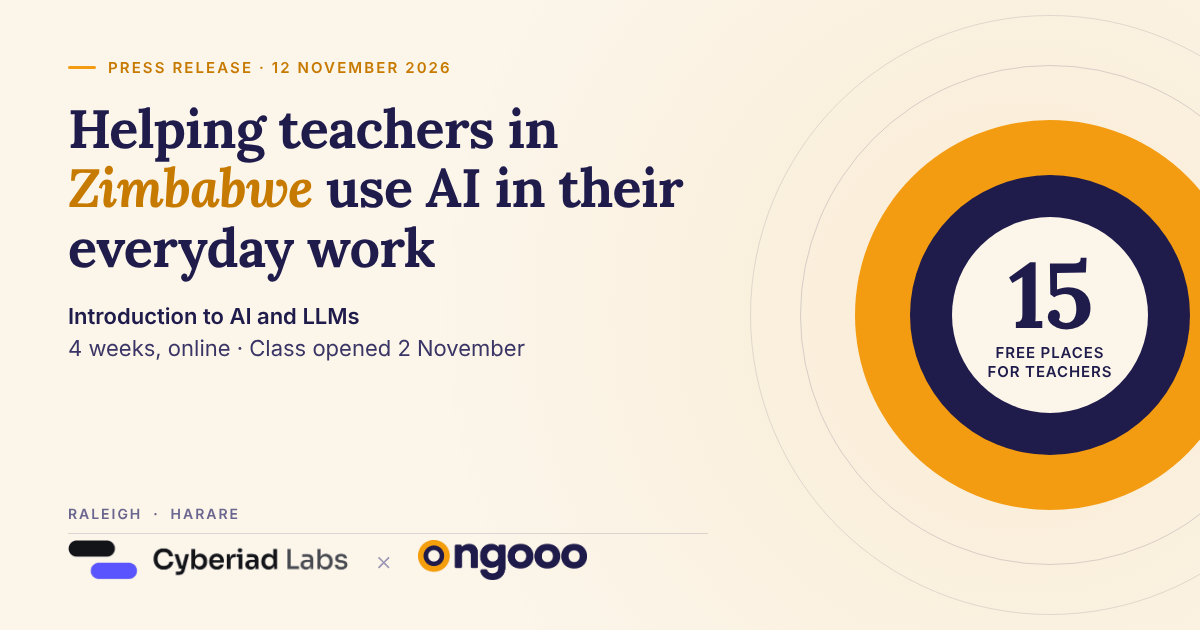
RALEIGH, N.C., and HARARE, Zimbabwe, 12 November 2026. Cyberiad Labs and Ongororo today announced a partnership that gives teachers free places in Cyberiad Labs’ AI course: 15 places in the class that opened on Monday 2 November 2026, plus one for Ongororo’s founder, Alex Ushe. The course, Introduction to AI and LLMs, is online, part-time and four weeks long.
Ongororo’s places come on top of the public ones, which are full for every class until the end of 2026. This is the fifteenth education partnership Cyberiad Labs has announced, and its first in Zimbabwe.
Alex Ushe, who is from Harare, graduated with a double major in business management and information technology. He has been building software solutions since 2015, and has worked in software development and in school IT and operations. In January 2026, he founded Ongororo to bring that experience together and help schools understand their information, make better decisions and support learners. Ongororo, a team of four, is based in Harare, and Alex leads its product and technical development. Its name is a Shona word meaning a deep analysis: the aim is to help schools go beyond collecting information, to understanding it and putting it to use.
Ongororo’s platform, ongooo, is an education SaaS (software as a service) platform that improves teaching and learning for teachers and students. Its AI helps each user identify what they need to focus on, keeps track of areas needing attention and drafts possible solutions. It also handles a school’s administration, such as fees, attendance, reports and messages to parents on WhatsApp. It manages more than 4,000 students across seven campuses, and Shining Smiles Group of Schools was the first to use it. Ongororo is now building a more accessible way for students to receive assignments and learning materials, complete their work and get support, with a growing focus on WhatsApp. The aim is for that activity to flow back to teachers, so they can see where their learners need help. This broader WhatsApp-first student experience is still in development; fees, attendance, reports and WhatsApp messages to parents are already live.
Zimbabwe’s government wants AI in its classrooms. It launched its National Artificial Intelligence Strategy 2026–2030 in March. In May, Sifiso Ndlovu, chief executive of the Zimbabwe Teachers’ Association, called for teachers to be trained in AI, so they are not left behind by students who can already use it. Since then, the ICT minister, Tatenda Mavetera, has announced plans to make AI, coding, robotics and the internet of things compulsory in primary and secondary schools.
AI can also give teachers time back. In a 2025 Gallup and Walton Family Foundation survey of more than 2,200 public school teachers in the United States, those who used AI at least weekly estimated that it saved them 5.9 hours a week on average. Of the nine tasks the survey asked about, teachers were most likely to say AI saved them time on worksheets or assessments, administrative work and lesson preparation.
“Our email announcing our first partnership, with the Mandela AI Hub Foundation, is what started our conversation with Alex. Six weeks later, we’re announcing our fifteenth,” said Julien Barbier, co-founder of Cyberiad Labs. “Ongororo uses AI to help schools make sense of their data, and Alex still wants teachers to understand AI for themselves: where it saves time, where it gets things wrong, and how to keep their students’ information safe. That’s the right instinct. A teacher who checks what AI says will teach their students to check it too.”
“I want teachers in Zimbabwe to feel confident using AI in ways that genuinely help their everyday work, from lesson preparation and learning materials to marking support, reports and communication with parents,” said Alex Ushe, founder of Ongororo. “The goal is to help them understand where AI is useful, and where their own knowledge and judgment must remain central. My hope is that they can spend less time on repetitive tasks and more time understanding and supporting their students. This partnership gives us a practical place to start.”
Cyberiad Labs’ Introduction to AI and LLMs (large language models) is for everyone, whatever their field, and needs no coding. It teaches learners what AI is, how it works and where it fails. In the first week, they see that the system answering so confidently is a program predicting text, one small piece at a time, and that it can be wrong. Throughout the course, they practise checking its answers, asking for its sources and verifying them, and deciding for themselves when to rely on it.
Learners who pass the four weekly quizzes earn a certificate they can add to their LinkedIn profile, where anyone can check that it is real. Cyberiad Labs’ first class opened on 14 September with 1,005 learners from 51 countries, 95% of them in Africa, and rated its sessions 4.8 out of 5 on average.
“Teachers handle information that belongs to children: their marks, their reports, their families’ details,” said Youssef Charif Hamidi, co-founder of Cyberiad Labs. “On the first day of the course, every learner installs a small AI model on their own device. What they type into it stays there, and it keeps working when the internet drops. An online chatbot is different: what you type goes to someone else’s servers, and a teacher should know that before pasting in a student’s work.”
Teachers registered through a link Cyberiad Labs sent Ongororo, and follow the course on laptops. The course is in English, written in plain words for people whose first language is not English, and every chapter has a player that reads it out loud. After this first class, Ongororo and Cyberiad Labs will look at what the teachers found useful and applied in their work. Ongororo also has 50 free places in Class 3, which starts on 11 January 2027: schools and teachers who are interested can write to Ongororo at alex@ongororo.com. Non-profits and foundations that don’t charge their learners can ask for free places of their own at julien@cyberiadlabs.com.
About Cyberiad Labs
Cyberiad Labs teaches people to work with AI without handing it their thinking. Those skills help people keep a job or find one, and help organisations keep up as AI changes their work. It teaches learners directly, and works with schools, universities, companies, NGOs and governments.
Julien Barbier co-founded Holberton School, a software engineering school with no teachers, no lectures and no upfront tuition. It grew from one campus in San Francisco to 32 worldwide before it was acquired. He then led product and growth at ALX across its software engineering and applied AI programmes, where the number of learners went from a few thousand to more than 1.6 million. Before Holberton, he was the first head of marketing, growth and community at Docker.
Youssef Charif Hamidi is a full-stack engineer. He learned to code on Julien’s 12-month ALX software engineering programme. He finished it on an Android tablet, because cerebral palsy limits him to about two words a minute on a computer keyboard. Previously, he built MathVellum, a maths editor for people who cannot hold a pen.
Home: https://www.cyberiadlabs.com
About Ongororo
Ongororo is an education intelligence platform helping schools in Zimbabwe simplify learning and administration and make better-informed decisions. We bring together school teaching and learning, with a growing focus on WhatsApp-first access to students. Our goal is to make useful information and learning support more accessible to school leaders, teachers, parents and learners. https://www.ongororo.com
Contact information
Julien Barbier, co-founder, Cyberiad Labs, julien@cyberiadlabs.com
Alex Ushe, founder, Ongororo, alex@ongororo.com
Sources
- United Nations in Zimbabwe, “Zimbabwe Unveils 2026–2030 AI Strategy to Advance Inclusive Digital Transformation”, 14 March 2026.
- Southern Eye (NewsDay), “Rural schools face digital exclusion as teachers lag behind in AI, tech skills”, 28 May 2026.
- Tech Review Africa, “Zimbabwe to make AI, Coding, IoT and Robotics compulsory in schools”, 4 August 2026.
- Gallup, “Three in 10 Teachers Use AI Weekly, Saving Six Weeks a Year”, 24 June 2025.
- Walton Family Foundation, “The AI Dividend: New Survey Shows AI Is Helping Teachers Reclaim Valuable Time”, 25 June 2025.